
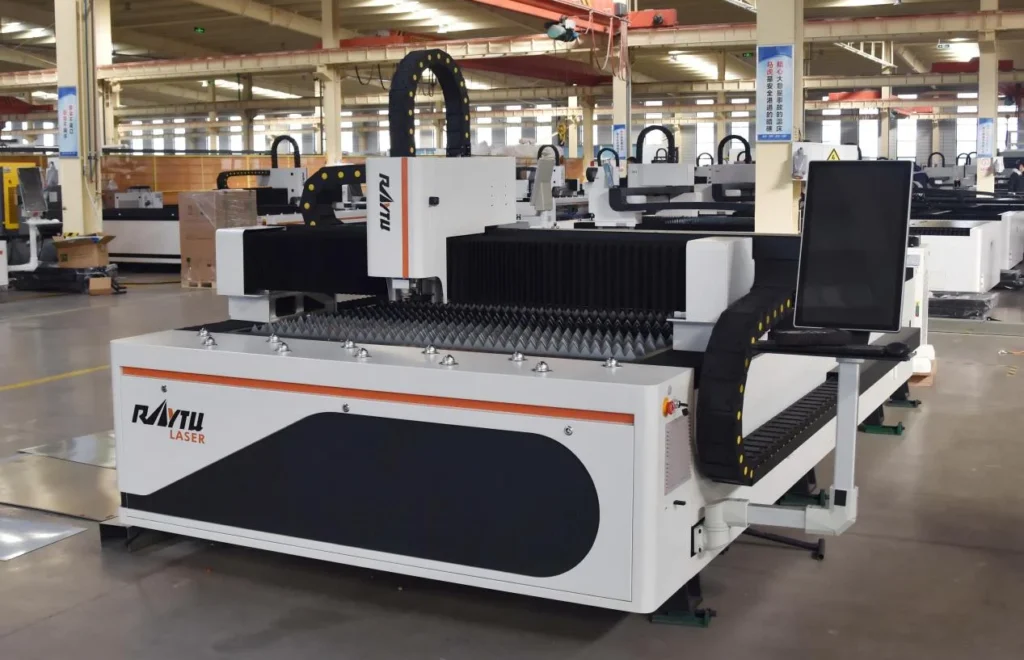
Cold weather is already in the northern hemisphere, and the first hard frost is the deadline for this job. If the cooling water in a laser freezes, the damage is mechanical, not electrical, and it is not covered by guesswork.
Two outcomes are possible. In the mild case you get a flow or temperature alarm and lose a production shift. In the serious case the water freezes inside the cooling plates, the ice expands, the plates crack, and coolant reaches the optics or the pump chamber. That unit goes back to the factory.
None of this is difficult to prevent. It takes about twenty minutes and one of the three methods in section 3.
1. How freezing damages the cooling circuit
Water expands by roughly 9% when it turns to ice. Inside a closed loop there is nowhere for that expansion to go, so the pressure has to be absorbed by the weakest part of the circuit: the water-cooling plates, the water distributor, the fittings, the flow meter.
The photographs below are from units returned to us after a freeze. Both failed at a seam, not in the middle of a plate, because that is where the wall is thinnest.
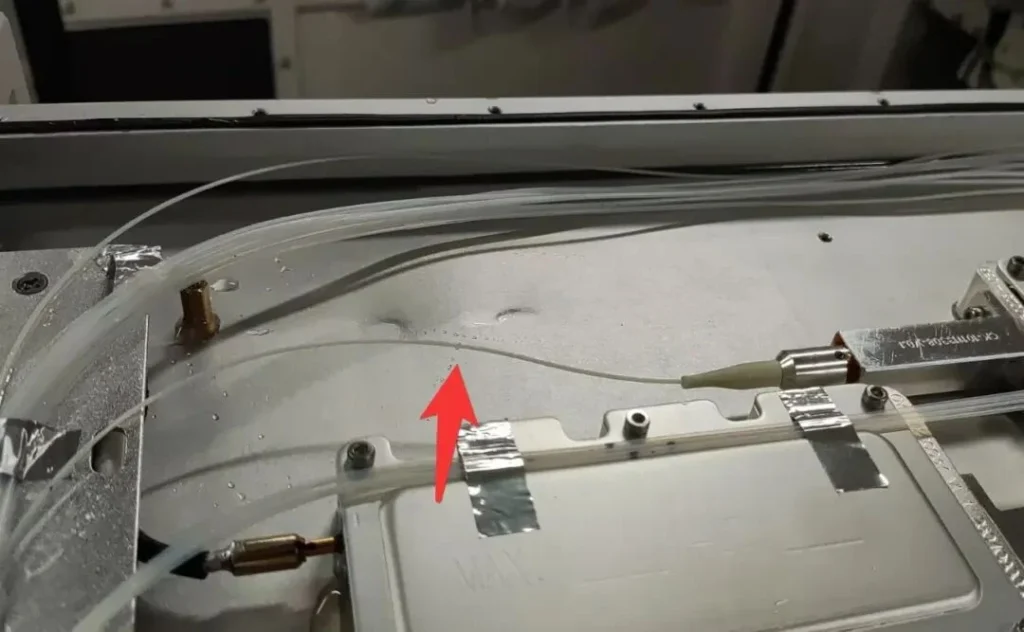
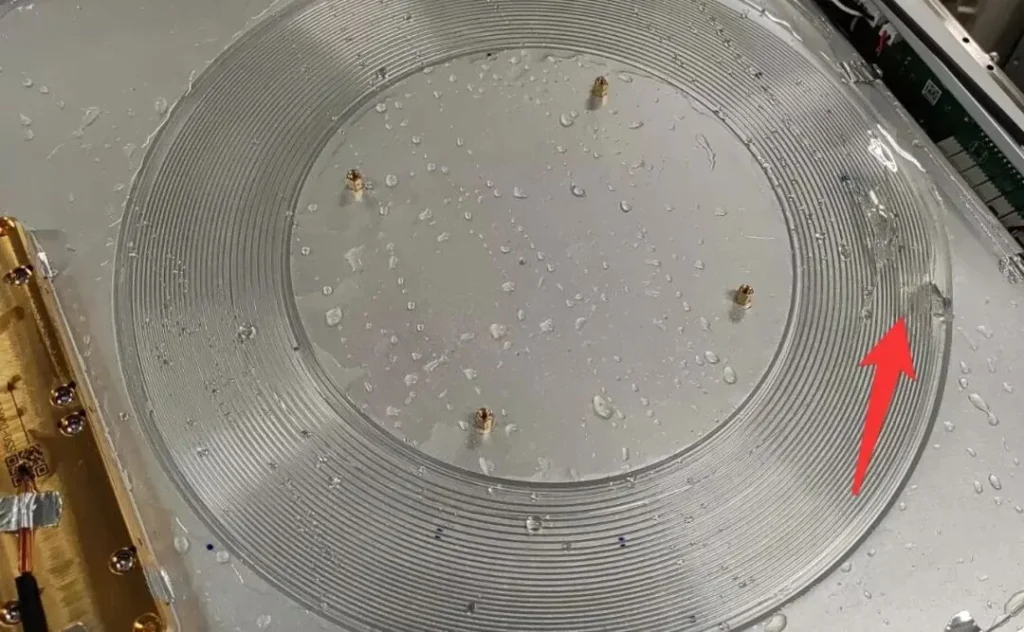
A crack of a few tenths of a millimetre is enough. Once coolant leaks into the laser head, the repair is no longer a plate replacement.
This is why freeze protection is a scheduled maintenance item, not an optional precaution. It has to be done before the first night below zero, not after.
2. Temperature settings
The laser is designed to run in an ambient temperature of 10 °C to 40 °C. Inside that range, the chiller setpoints depend on what is in the loop and whether the machine is working.
| Condition | Low-temperature circuit | High-temperature circuit | Notes |
| Running, deionized water | 20 °C in winter, 24 °C in summer | 28–30 °C | Standard production setting |
| Running, antifreeze in loop | 18–20 °C | 28–30 °C | Antifreeze lowers heat transfer, so the setpoint comes down |
| Idle but powered | ~5 °C | ~5 °C | Holds the loop above freezing on low energy; only with reliable power |
| Shutdown or transport | Drain | Drain | See section 3.3 |
Before you fire the laser, let the chiller circulate for at least 20 minutes. In cold weather allow longer: do not start emission until the actual water temperature has reached the setpoint and the laser’s internal sensors are up to operating temperature. Starting cold is the most common cause of a first-shot alarm in winter.
When the weather warms up and you flush the antifreeze out, set the low-temperature circuit back to 20–24 °C and leave the high-temperature circuit at 28–30 °C.
3. Five protective measures
Pick one method that matches your site. You do not need all five, but you do need at least one of 3.2, 3.3 or 3.4.
3.1 Keep the ambient temperature up
Keep the laser’s operating environment between 10 °C and 40 °C with whatever heating is available. Overnight, when the workshop is empty, the equipment must not sit below 0 °C for long periods. A cheap frost-stat and a space heater cost far less than a cooling plate.
3.2 Leave the chiller running
If your power supply is reliable, leave the chiller running through idle periods. Set both the low-temperature and the high-temperature circuits to about 5 °C. This holds the loop above freezing while drawing less power than the normal production setpoint.
Do not use this method if outages are common. A chiller that stops at 2 a.m. in a −8 °C workshop protects nothing, so move to 3.3 or 3.4 instead.
3.3 Drain the cooling water after every use
This is the most reliable method and the one we recommend for sites with unreliable power.
- Disconnect the water inlet hose from the laser.
- Blow clean, dry compressed air through the WATER IN port until no more water comes out of WATER OUT. Keep the pressure below 8 bar; higher pressure can damage the internal piping.
- Close the valves and plug both ports with rubber stoppers so debris cannot enter the circuit.
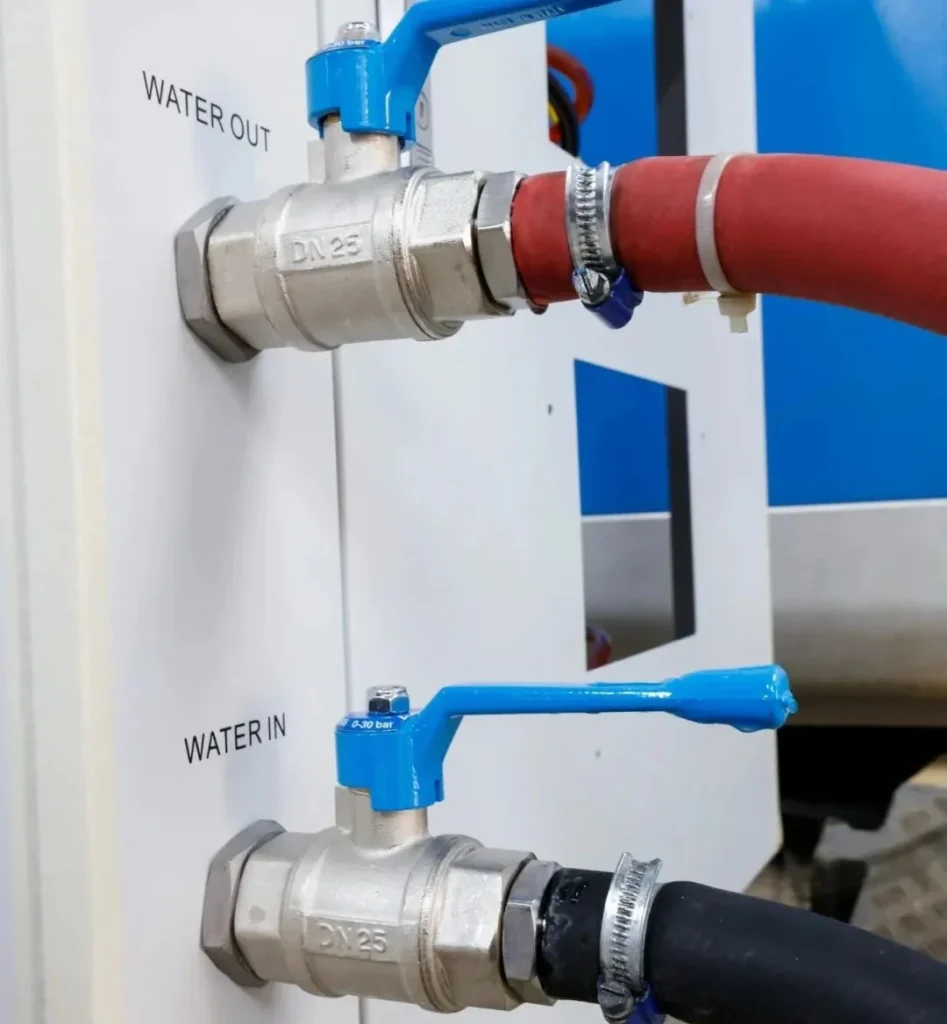
Drain the chiller as well, not only the laser. Water left in the chiller’s own tank and pump will freeze just as readily.
3.4 Use antifreeze
Add antifreeze if the ambient temperature can drop below 0 °C, if outages are frequent, or if draining every day is not practical.
- Choose the freezing point from your local climate. Pick a product rated 5–10 °C below the lowest temperature recorded in your area in the past ten years. A lower freezing point is not automatically better: higher concentration means worse heat transfer.
- Mix to the manufacturer’s ratio. Do not increase the concentration because it “feels safer”. Over-concentration is a common cause of high-temperature alarms in winter.
- Add 5–10% industrial ethanol (by total cooling water volume) to deionized or purified water if you have had problems with mould or algae blocking the circuit.
- Do not use rubber hoses containing chloride ions or halogens for the external water lines. Chloride leaching attacks the piping and the plates.
Antifreeze is a winter measure, not a permanent fill. Once the ambient temperature stays above 10 °C, flush the system and return to deionized or distilled water.
3.5 Water quality and piping
Use deionized or distilled water only. Conductivity should be below 60 μS/cm (TDS below 30 mg/L), with no detectable chloride and no visible particles.
Test the water monthly and replace it as soon as it fails. In any case, replace it at least every three months.
On layout: put the laser and the chiller on the same horizontal level where possible. Keep the low-temperature hoses to 2 m or less, and use high-temperature hoses with an internal diameter of at least 8 mm, no longer than the armoured cable they run alongside.
4. Power-on and power-off sequence
Getting the order right adds years to the equipment.
Power on: chiller first (at least 10 minutes in winter, 20 minutes or more is better) → then the laser unit → then emission.
Power off: laser unit first → then the chiller.
If the machine will be idle for more than one hour, shut off the water supply and the power. If it will be idle for more than eight hours, turn off the main switch.
Water hammer
Water hammer is the pressure spike that travels down the pipe when a valve closes against moving water. It can crack fittings and, in the worst case, the cooling plate. Three rules prevent it:
- With a laser and chiller connected, always switch the chiller off before operating any ball valve in the cooling circuit.
- When supplying water, open the ball valve on the outlet side first, then the inlet side.
- When shutting off the water, close the inlet side first, then the outlet side.
5. Reading the alarm codes
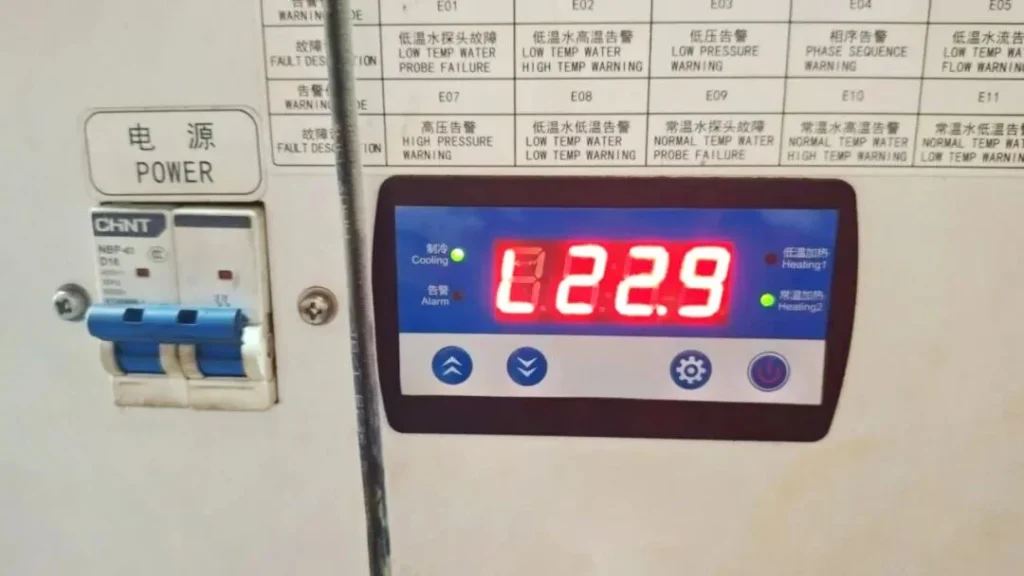
The chiller nameplate carries the alarm code list. Most winter calls we take are one of these:
| Code | Alarm | First check |
| E01 | Low temp water probe failure | Sensor connector and cable |
| E02 | Low temp water high temp warning | Water level, flow, ambient temperature |
| E03 | Low pressure warning | Refrigerant pressure; call service |
| E04 | Phase sequence warning | Three-phase supply order after any rewiring |
| E05 | Low temp water flow warning | Pump running, filter blocked, hose kinked or frozen |
| E07 | High pressure warning | Condenser airflow and dust build-up |
| E08 | Low temp water low temp warning | Setpoint and antifreeze concentration |
| E09 | Normal temp water probe failure | Sensor connector and cable |
| E10 | Normal temp water high temp warning | Water level, flow, ambient temperature |
| E11 | Normal temp water low temp warning | Setpoint and antifreeze concentration |
Codes as printed on the unit. E06 sits outside the frame of the photograph above, so confirm it against your manual.
If a temperature or flow alarm appears, do not fire the laser and do not keep restarting the machine. Check the water temperature, the flow rate, the water quality and the process parameters first. If the alarm persists, shut the machine down and call us.
One point worth knowing: adding antifreeze reduces both the heat-transfer capacity and the flow rate of the coolant, so the laser’s overall heat dissipation drops. If you get temperature alarms after switching to antifreeze, that is usually why. Do not restart repeatedly. Call after-sales support and we will walk you through the settings at no charge.
6. Long shutdowns and extreme cold
More than one week idle, before transport, or over a holiday shutdown: drain all coolant from the equipment. Blow dry compressed air (below 8 bar) through the whole circuit, laser and chiller both, until no water remains. Water left in a machine that sits for weeks causes corrosion and blockages as well as freeze damage.
Below −15 °C ambient: use a chiller with a dual-function (cooling and heating) system and keep it running continuously. No antifreeze concentration is a substitute for a heated loop at that temperature.
Checklist before the first frost
- Ambient stays above 0 °C overnight, or the loop is drained, or antifreeze is in.
- Chiller setpoints match the table in section 2.
- Water conductivity tested, and the water replaced if it failed.
- Hoses inspected: no chloride rubber, low-temperature runs under 2 m.
- Chiller runs 20 minutes before the first shot of the day.
- Operators know not to restart the machine on a flow or temperature alarm.
Ten minutes with this list is cheaper than a return-to-factory repair, and considerably cheaper than a missed delivery.
If you are unsure which method suits your site, or you need help with antifreeze ratios or water testing, contact the Raytu Laser after-sales team. We will advise on your specific model and configuration.