
Pulsed and continuous laser cleaning use the same basic physics and produce very different results. One is a precision tool, the other is a production tool, and choosing the wrong one costs you either throughput or part quality. This guide breaks down where they actually differ.
Where the laser cleaning industry is heading
Laser cleaning uses a focused, high-density beam to strip rust, paint, oxide and coatings from metal, stone and composite surfaces. It uses no chemicals and no abrasives, which makes it a direct replacement for sandblasting, chemical stripping and manual grinding, and it leaves no secondary waste stream to dispose of.
Market research puts the global laser cleaning market at USD 659.92 million in 2023, growing at a CAGR of 4.10% to reach USD 883.65 million by 2031. Regulation is doing part of that work: tightening restrictions on volatile solvents and open abrasive blasting keep pushing workshops toward dry, chemical-free processes.
Demand is not uniform, though. A shipyard needs to strip square metres per hour. A mould shop needs to lift a five-micron layer without touching the cavity geometry. An aerospace supplier needs to prepare a weld seam on two-millimetre aluminium without annealing it. Those are three different machines.
That is why the pulsed-versus-continuous decision matters more than any single specification on a datasheet. The two technologies cover different scales of work, from heavy removal to mid-scale maintenance to precision cleaning, and most suppliers serving several industries end up stocking both.
What is pulsed laser cleaning?
Pulsed laser cleaning delivers the beam in short, controlled bursts instead of a steady stream. A pulsed source, typically nanosecond fibre, fires thousands of pulses per second, and each pulse deposits a small, repeatable packet of energy into the contamination layer rather than into the substrate beneath it.
Typical average power runs from 100 W to 500 W. Because the energy arrives in bursts, the average heat load stays low and the risk of burning or distorting the surface drops sharply. That is the whole reason pulsed cleaning is the default choice for thin, heat-sensitive or dimensionally critical parts.
What is continuous laser cleaning?
Continuous laser cleaning, also called CW cleaning, emits an uninterrupted beam for as long as the trigger is held. The source runs at constant output, and material removal comes from sustained energy delivery rather than discrete pulses.
CW cleaners usually run between 1,000 W and 3,000 W. That power removes contamination fast, but it also creates a real heat-affected zone. Dwell too long in one spot and you can discolour, warp or even cut the surface, so correct parameter settings and operator technique are not optional.
Pulsed vs. continuous laser cleaning: the differences
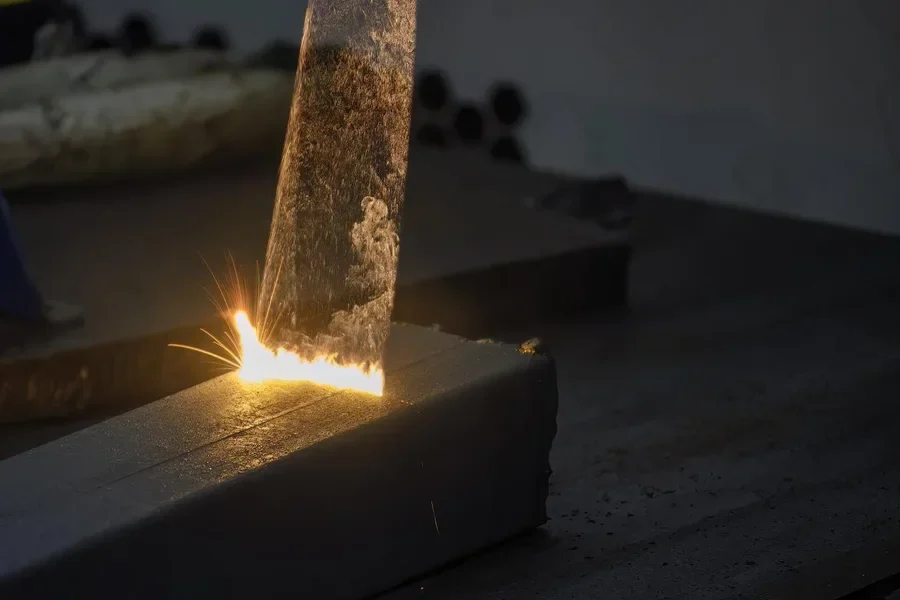
Both technologies clean with a focused beam, but they behave differently at the workpiece, and that difference drives everything downstream: fixture design, cycle time, operator skill and cost per part.
The differences that matter most:
Control and precision
Pulsed cleaning is the more controllable of the two. Short, high-density bursts abrade and vaporise contamination in a measured way, and because the beam can be aimed at a small spot, awkward geometry is far easier to handle: curved surfaces, fillets, weld seams, the inside of tubes and the details of a mould cavity.
A CW beam is not selective in the same way. It cleans a wider area at once, so tight or curved geometry needs more passes, more masking and more operator time, and the result is usually less consistent. On a small or complex part, continuous cleaning is simply more work for a worse finish.
Speed
On flat, large-area work, CW wins on throughput. An uninterrupted beam delivers uniform cleaning across big panels, which is why it dominates high-volume production and heavy fabrication.
Pulsed cleaning is slower by design. The beam does less work per second in exchange for control, so it is a poor fit for stripping a twenty-metre hull or a warehouse of structural steel. If cycle time is the constraint, the answer is continuous.
Heat input and surface safety
Pulsed units draw 100 W to 500 W and put very little heat into the part. That makes them suitable for thin sheet, detailed castings, tooling and anything where distortion, annealing or a change in surface finish is unacceptable.
CW units draw 1,000 W to 3,000 W. Temperature at the spot climbs quickly, and without correct parameters and dwell control you risk warping, micro-cracking or an altered surface layer. The machine will do it; the process has to be set up to allow it.
Applications
Pulsed cleaning suits work where the surface itself is the asset: automotive and aerospace pre-treatment before coating or welding, mould and tool cleaning, electronics and precision components, thin-walled parts, and restoration work on delicate substrates.
CW cleaning suits high-volume work on robust substrates: structural steel, plate, heavy fabrication, shipbuilding and rail, where speed and cost per square metre beat finesse. Both are used in the same factory more often than the marketing suggests.
Cost and return
Purchase price tracks average power. A 100 to 500 W pulsed unit costs less to buy than a 1,000 to 3,000 W CW unit, so the entry ticket is lower.
The economics flip when you look at cost per square metre instead of sticker price. CW removes more area per hour, so labour, usually the dominant cost in any cleaning operation, is spread thinner. On the right job a CW machine can pay for itself inside a year. On precision work the pulsed machine pays back by eliminating rework, masking time and scrapped parts. That is why stocking both, rather than arguing about which technology is better, is usually the commercial answer.
How to choose the right laser cleaning method
The two technologies share a principle but not a behaviour. Choose by the surface and the cycle time, not by the specification sheet.
Three questions decide it:
What is the surface?
Delicate substrates need pulsed: thin sheet, glass, wood, composites, anodised or polished finishes. It removes the layer without attacking what is underneath, and it reaches curved geometry and the inside of tubes where a CW beam cannot clean evenly.
Hard, thick, heavily contaminated steel does not need that finesse. CW is faster and cheaper per square metre, and the heat it puts in is irrelevant on a 20 mm plate that is going to be welded anyway.
How much time do you have?
If the job is throughput-driven, choose CW: large areas, one pass, minimal masking. If the job is quality-driven, such as a mould cavity, a weld prep on thin aluminium or a part that cannot be reworked, accept the slower cycle and take the control.
What is the real cost?
Compare total cost, not sticker price: machine, extraction, fixturing, labour per hour, consumables (close to zero for both) and scrap rate. A cheap machine that damages three percent of parts is not cheap, and a fast machine that needs two extra operators to keep up is not fast.
Conclusion
Laser cleaning is not just a cost line, it is a capability. Chemical-free, abrasive-free and dry, it removes a waste stream and a labour bottleneck at the same time, and it does it in a single pass with no media to buy or dispose of.
Pulsed is the precision tool: low heat, high control, best on thin, delicate or geometrically awkward surfaces, and slower on area. Continuous is the production tool: high power, high throughput, best on robust flat work where finish tolerances are loose.
For most workshops running mixed work, the practical answer is to specify both: a 200 W pulsed unit for detail and a 1.5 to 2 kW CW unit for volume, then route jobs by surface and cycle time instead of forcing one machine to do everything.
Not sure which configuration fits your parts? Send us a sample and we will run it on both.